
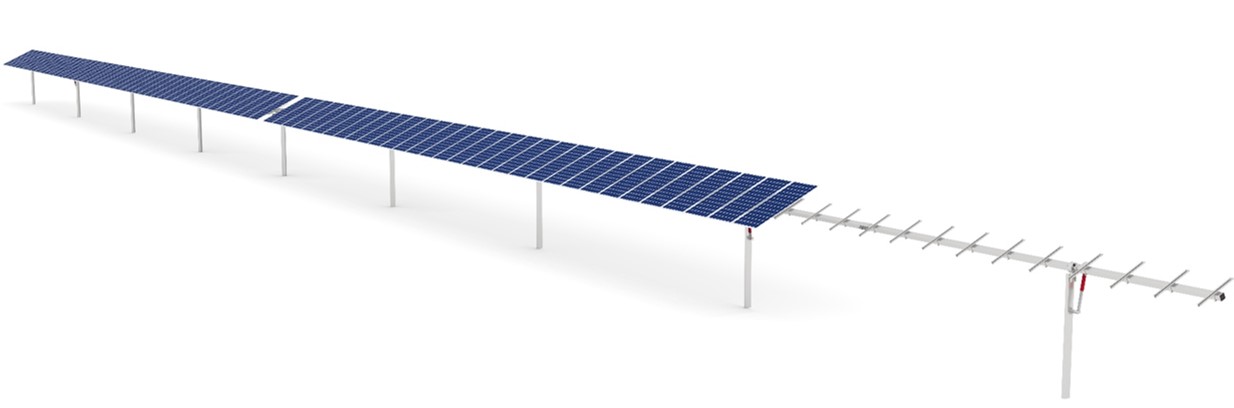
The BiT-1P is JUPOWER's main single-axis tracking bracket. Since its first commercial use in 2021, it has been operating in more than 100 projects worldwide, accumulating a total capacity of over 2.5GW, with the earliest projects operating stably for more than 5 years.
Why choose BiT-1P?
The power generation is 15%-25% higher than that of the fixed support.The BiT-1P's ±60° tracking range, combined with the JU-SMART intelligent algorithm, can generate 15%-25% more power than fixed-support projects of the same capacity. In well-lit areas, this typically improves the project's IRR by 1-2 percentage points.
It can withstand a Category 17 typhoon (160 km/h) and has been verified in the field.The entire unit has passed IEC 62817 wind tunnel testing. With the TCU high wind protection mode, the support structure automatically returns to its original level when the wind speed exceeds a threshold, reducing wind resistance. Projects in strong wind regions such as Italy, Argentina, and South Africa have been operating stably for 3-7 years.
It can be used in mountains, deserts, and complex terrains.The tracker is adaptable to irregular terrain with varying slopes. A single unit can independently control up to four strings of modules, and can be shut down individually in corner areas without affecting other strings. It has already been delivered to various terrains, including complex mountains in Italy, the deserts of Argentina, and jungles in Southeast Asia.
On-site assembly is fast, saving half the labor.It boasts a high pre-assembly rate, with only three main types of standard parts. Installing a BiT-1P set is 30%-40% faster than traditional brackets, directly resulting in savings in construction time and hoisting costs for EPC projects.
The control system does not rely on third partiesThe TCU, NCU, and control algorithm are all independently developed by Juzhiyi. Customers receive a complete closed loop of "hardware + algorithm + protocol," ensuring they can find support for future maintenance, upgrades, and secondary development, and will not be held back by technology.
【Typical Application Scenarios】
Large-scale flat-ground power plants (main application scenarios), complex mountainous areas and irregular boundaries, agricultural-solar complementary and fishery-solar complementary projects, deserts, strong wind areas and typhoon areas, and EPC projects that require rapid grid connection and are sensitive to construction period.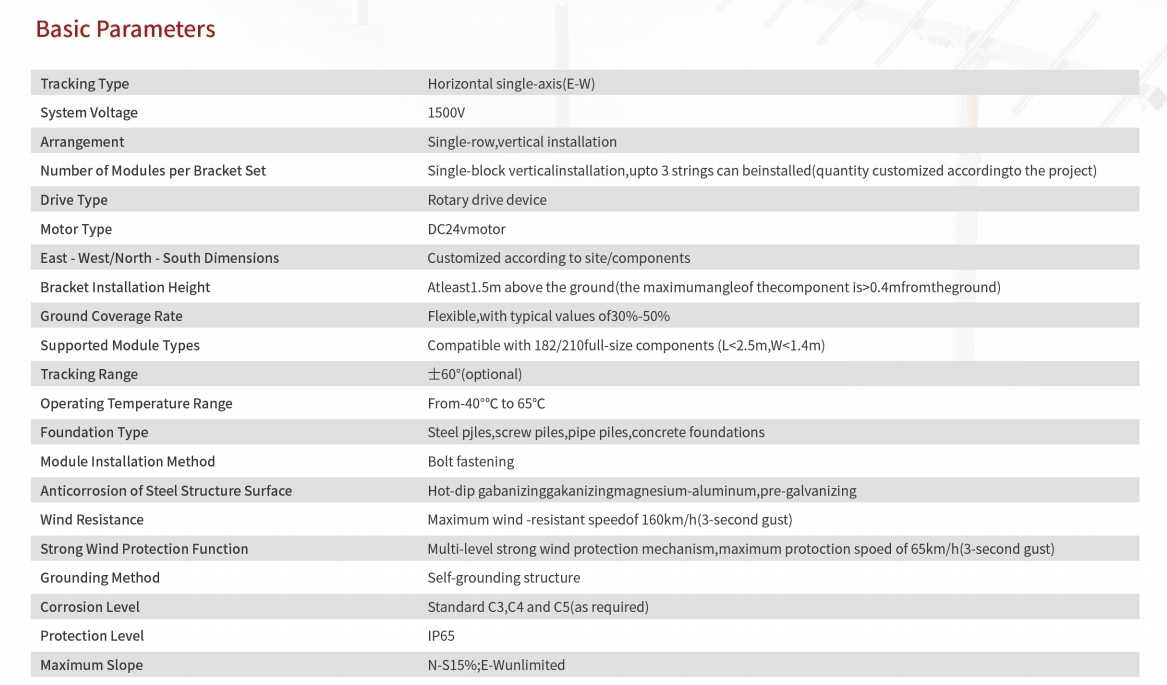
 EN
 ZH_CN